

- University
- Academic
- Schools/Vocational Schools
- Vocational School of Justice
- Vocational School
- Vocational School
- Department of Banking and Insurance (Turkish)
- Department of Computer Programming (Turkish)
- Department of Foreign Trade (Turkish)
- Department of Graphic Design (Turkish)
- Department of Interior Design (Turkish)
- Department of Construction Technology (Turkish)
- Department of Occupational Health and Safety (Turkish)
- Department of Media and Communication (Turkish)
- Department of Architectural Restoration (Turkish)
- Department of Radio and Tv Programming (Turkish)
- Department of Civil Aviation Cabin Services (Turkish)
- Department of Civil Aviation Transportation Management (Turkish)
- Department of Tourism and Hotel Management (Turkish)
- Department of Applied English Translation
- Vocational School Of Health Services
- Vocational School Of Health Services
- Department of Child Development (Turkish)
- Department of Physiotherapy (Turkish)
- Department of Paramedic (Turkish)
- Department of Opticianry (Turkish)
- Department of Medical Documentation and Secreteriat (Turkish)
- Department of Medical Imaging Techniques (Turkish)
- Department of Medical Laboratory Techniques (Turkish)
- Department of Elderly Care (Turkish)
- School of Applied Management Sciences
- School of Foreign Languages
- Faculties
- Faculty of Arts and Sciences
- Faculty of Fine Arts and Design
- Faculty of Law
- Faculty of Communication
- Faculty of Business
- Faculty of Engineering
- Faculty of Engineering
- Department of Computer Engineering
- Department of Biomedical Engineering
- Department of Electrical and Electronics Engineering
- Department of Industrial Engineering
- Department of Food Engineering
- Department of Genetics and Bioengineering
- Department of Aerospace Engineering
- Department of Civil Engineering
- Department of Mechanical Engineering
- Department of Mechatronics Engineering
- Department of Software Engineering
- Faculty of Health Sciences
- Medicine
- Graduate School
- Common Courses
- Schools/Vocational Schools
- Research
- Research Centers
- Library
- Smart Campus
- Technology Transfer Office
- İzmir Sciencepark
- Continuous Education Center (EKOSEM)
- Children's University
- Ethics Committee
- Teaching and Learning Center (EKOEĞİTİM)
- Psychology Application and Research Center
- Researcher Training Coordinatorship
- Research Collaborations And Innovation Coordinatorship
- Campus
- INTERNATIONAL
- Contact
- 25TH YEAR
Department of Political Science and International Relations
PSIR 444 | Course Introduction and Application Information
| Course Name |
International Relations Through Motion Pictures
|
|
Code
|
Semester
|
Theory
(hour/week) |
Application/Lab
(hour/week) |
Local Credits
|
ECTS
|
|
PSIR 444
|
Fall/Spring
|
3
|
0
|
3
|
6
|
| Prerequisites |
None
|
|||||
| Course Language |
English
|
|||||
| Course Type |
Elective
|
|||||
| Course Level |
First Cycle
|
|||||
| Mode of Delivery | face to face | |||||
| Teaching Methods and Techniques of the Course | - | |||||
| National Occupation Classification | - | |||||
| Course Coordinator | ||||||
| Course Lecturer(s) | ||||||
| Assistant(s) | ||||||
| Course Objectives | The objective of this course is to acquaint students with the nature, structure, functioning and evolution of international system by paying tribute to international relations’ current issues, notions and challenges. The course will be using movies as a teaching tool for visualized representation of the issues at stake. |
| Learning Outcomes |
The students who succeeded in this course;
|
| Course Description | In this course, movies and documentaries that students would be expected to watch before attending lectures would be used for analyzing and debating some of the current themes of international relations. Focus of the course will be on the more visible of current issues and challenges of international relations such as terrorism, failed states, environmental problems, migration, peacekeeping, technological warfare, weapons of mass destruction and cyber threats. |
| Related Sustainable Development Goals |
|
|
|
Core Courses | |
| Major Area Courses |
X
|
|
| Supportive Courses | ||
| Media and Management Skills Courses | ||
| Transferable Skill Courses |
WEEKLY SUBJECTS AND RELATED PREPARATION STUDIES
| Week | Subjects | Related Preparation |
| 1 | Introduction: Course objectives, course content, methodology and logistics. Meaning and scope of IR | Overview of the course and International relations. |
| 2 | Realist Paradigm | The Lord of the Flies (1963). Suggested reading: Paul Poast, “A World of Power and Fear,” Foreign Affairs, June 15, 2022; Jonathan Kirshner, “Trump’s America First Is Not Realism,” Foreign Affairs, January 22, 2025. |
| 3 | Liberal Paradigm | Independence Day (1996). Suggested reading: Michael Doyle, “Why They Don’t Fight,” Foreign Affairs, June 18, 2024; John Ikenberry, “The Next Liberal Order,” Foreign Affairs, July/August 2020; Stephen M. Walt, “An International Relations Theory Guide to the War in Ukraine,” Foreign Policy, March 8, 2022; Chung-in Moon, “America: The Biggest Danger to the Security of the World?” Hankyoreh, September 5, 2023. |
| 4 | United Nations, R2P, Peacekeeping | Siege of Jadotville (2016). Suggested reading: Stephen R. Weissman, “What Really Happened in Congo,” Foreign Affairs, July/August 2014; Myemba Phezo Dizolele, “ A Cold War That Still Haunts Congo,” Foreign Policy, December 20, 2023; Farnaz Fassihi, “The World Has Changed, but Can the U.N.?” The New York Times, September 29, 2023; Barbara F. Walter, Lise Morjhé Howard and V. Fortna, “The Astonishing Success of Peacekeeping,” Foreign Affairs, November 29, 2021. |
| 5 | New War and Failed States | Beasts of No Nation (2015). Suggested reading: Jason K. Stearns, “Rebels Without a Cause,” Foreign Affairs, May/June 2022;“The world’s deadliest war last year wasn’t in Ukraine,” The Economist, 17 April 2023. |
| 6 | Human Security, Population Movements | Adu (2020). Suggested reading: The Economist, “Who counts as a refugee?” July 27, 2021; Lydia Polgreen, “Something Extraordinary Is Happening All Over the World,” The New York Times, January 31, 2025. |
| 7 | Environmental Issues in IR | Before the Flood (2016). Suggested reading: Joshua Busby, “Warming World,” Foreign Affairs, June 14, 2018; Somini Sengupta and Lisa Friedman, “Trump to World: Green Energy Is a Scam and Climate Science Is from Stupid People,” The New York Times, September 23, 2025. |
| 8 | Midterm exam | |
| 9 | Terrorism | Munich (2005)) Suggested readings: Cynthia Miller-Idris, “From 9/11 to 1/6,” Foreign Affairs, September/October 2021; The Economist, “Beware, global jihadists are back on the march,” April 29, 2024. |
| 10 | Technological Warfare | A Good Kill (2014) Suggested readings: Robert Malley, “The Long Shadow of 9/11,” Foreign Affairs, June 14, 2018; The Economist, “The war in Ukraine shows how technology is changing the battlefield”, July 3, 2023. |
| 11 | Cold War; bipolar vs. uni-polar vs. multi-polar world order | Thirteen Days (2000). Suggested reading: Stephen M. Walt, “I Knew the Cold War”, Foreign Policy, 12 March 2018; Sergey Radchenko and Vladislav Zubok, “Blundering on the Brink,” Foreign Affairs, May/June 2023. |
| 12 | Weapons of Mass Destruction | The Sum of All Fears (2002). Suggested reading: Patricia Jaworek and Isabelle Williams, “The House of Dynamite sequel you didn’t know you needed,” Bulletin of the Atomic Scientists, October 31, 2025; Melissa Gillis, Disarmament – A Basic Guide, 3rd ed., United Nations, pp.17-27, 39-49; Megan DuBois, “A House of Dynamite Isn’t Explosive Enough,” Foreign Policy, October 24, 2025; Hans Kristensen and Matt Korda, “Why we should worry about nuclear weapons,” The Washington Post, June 4, 2025. |
| 13 | Cyber Threats | Zer0Day (2016). Suggested reading:Sydney J. Freedberg and Theresa Hitchens, “Calling SolarWinds Hack Act of War Just Makes It Worse,” Breaking Defense, December 21, 2020; Michele Flournoy and Micheal Sulmeyer, “Battlefield Internet”, Foreign Affairs, August 14, 2018. |
| 14 | Thoughts on Future of IR | Gattaca (1997). Suggested reading: David A. Kirby, “Gattaca and the quiet doomsday of genetic determinism,” Bulletin of the Atomic Scientists, June 2026, 82(4); Loren Thompson, “Gene Wars,” Forbes, January 29, 2016; The Economist, “Full-genome screening for newborn babies is now on the cards,” May 13, 2022. |
| 15 | Review of the semester | |
| 16 | Final Exam |
| Course Notes/Textbooks | There is no specific textbook. Instead, students will be expected to watch assigned movies or documentaries prior to attending lectures. A preliminary listing of assigned movies and documentaries is available under the Weekly Subjects entry. Yet, this tentative listing may be subject to modifications throughout the semester depending on movies’ availability. Therefore, students would be expected to check the course’s IEULearn space every week for possible updates and new instructions. All assigned movies would be readily available online by gaining access to a variety of online sharing platforms (e.g. youtube, Netflix, itunes, etc.), though gaining such access may require subscription or fees, which would be the sole responsibility of students. |
| Suggested Readings/Materials | All recommended reading material would be readily to students for downloading in the course’s IEULearn page. |
EVALUATION SYSTEM
| Semester Activities | Number | Weigthing |
| Participation |
1
|
20
|
| Laboratory / Application | ||
| Field Work | ||
| Quizzes / Studio Critiques | ||
| Portfolio | ||
| Homework / Assignments | ||
| Presentation / Jury | ||
| Project | ||
| Seminar / Workshop | ||
| Oral Exams | ||
| Midterm |
1
|
40
|
| Final Exam |
1
|
40
|
| Total |
| Weighting of Semester Activities on the Final Grade |
3
|
60
|
| Weighting of End-of-Semester Activities on the Final Grade |
1
|
40
|
| Total |
ECTS / WORKLOAD TABLE
| Semester Activities | Number | Duration (Hours) | Workload |
|---|---|---|---|
| Theoretical Course Hours (Including exam week: 16 x total hours) |
16
|
3
|
48
|
| Laboratory / Application Hours |
16
|
0
|
|
| Study Hours Out of Class |
16
|
5
|
80
|
| Field Work |
0
|
||
| Quizzes / Studio Critiques |
0
|
||
| Portfolio |
0
|
||
| Homework / Assignments |
0
|
||
| Presentation / Jury |
0
|
||
| Project |
0
|
||
| Seminar / Workshop |
0
|
||
| Oral Exam |
0
|
||
| Midterms |
1
|
18
|
18
|
| Final Exam |
1
|
22
|
22
|
| Total |
168
|
COURSE LEARNING OUTCOMES AND PROGRAM QUALIFICATIONS RELATIONSHIP
|
#
|
Program Competencies/Outcomes |
* Contribution Level
|
|||||
|
1
|
2
|
3
|
4
|
5
|
|||
| 1 |
To be able to use the theoretical and practical knowledge acquired in the areas of Political Science and International Relations. |
-
|
X
|
-
|
-
|
-
|
|
| 2 |
To be able to have the basic knowledge of, and make use of other disciplines which contribute to the areas of Political Science and International Relations. |
X
|
-
|
-
|
-
|
-
|
|
| 3 |
To be able to distinguish the differences between classical and contemporary theories and to assess their relationship. |
X
|
-
|
-
|
-
|
-
|
|
| 4 |
To be able to recognize regional and global issues, and develop sustainable solutions based on research. |
-
|
-
|
X
|
-
|
-
|
|
| 5 |
To be able to assess the acquired knowledge and skills in the areas of Political Science and International Relations critically. |
-
|
X
|
-
|
-
|
-
|
|
| 6 |
To be able to transfer ideas and proposals on issues in the areas of Political Science and International Relations to other people and institutions verbally and in writing. |
-
|
-
|
-
|
-
|
-
|
|
| 7 |
To be able to identify the historical continuity and changes observed in the relations between the actors and institutions of national and international politics. |
-
|
-
|
-
|
X
|
-
|
|
| 8 |
To be able to examine concepts, theories, and developments with scientific methods in the areas of Political Science and International Relations. |
-
|
X
|
-
|
-
|
-
|
|
| 9 |
To be able to take responsibility as an individual and as a team member. |
-
|
-
|
-
|
-
|
-
|
|
| 10 |
To be able to act in accordance with the scientific and ethical values in studies related to Political Science and International Relations. |
-
|
-
|
-
|
-
|
-
|
|
| 11 |
To be able to collect data in the areas of Political Science and International Relations and communicate with colleagues in a foreign language ("European Language Portfolio Global Scale", Level B1). |
-
|
-
|
-
|
-
|
-
|
|
| 12 |
To be able to speak a second foreign language at a medium level of fluency efficiently. |
-
|
-
|
-
|
-
|
-
|
|
| 13 |
To be able to relate the knowledge accumulated throughout human history to their field of experience. |
-
|
-
|
-
|
-
|
-
|
|
*1 Lowest, 2 Low, 3 Average, 4 High, 5 Highest
NEWSALL NEWS


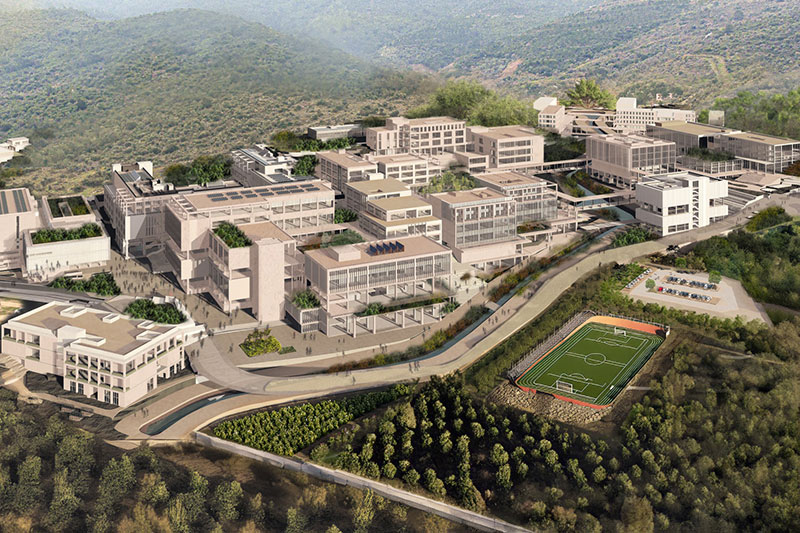
IZMIR UNIVERSITY OF ECONOMICS GÜZELBAHÇE CAMPUS
DetailsGLOBAL CAREER
As Izmir University of Economics transforms into a world-class university, it also raises successful young people with global competence.
More..CONTRIBUTION TO SCIENCE
Izmir University of Economics produces qualified knowledge and competent technologies.
More..VALUING PEOPLE
Izmir University of Economics sees producing social benefit as its reason for existence.
More..
You are one step ahead with your graduate education at Izmir University of Economics.