

- University
- Academic
- Schools/Vocational Schools
- Vocational School of Justice
- Vocational School
- Vocational School
- Department of Banking and Insurance (Turkish)
- Department of Computer Programming (Turkish)
- Department of Foreign Trade (Turkish)
- Department of Graphic Design (Turkish)
- Department of Interior Design (Turkish)
- Department of Construction Technology (Turkish)
- Department of Occupational Health and Safety (Turkish)
- Department of Media and Communication (Turkish)
- Department of Architectural Restoration (Turkish)
- Department of Radio and Tv Programming (Turkish)
- Department of Civil Aviation Cabin Services (Turkish)
- Department of Civil Aviation Transportation Management (Turkish)
- Department of Tourism and Hotel Management (Turkish)
- Department of Applied English Translation
- Vocational School Of Health Services
- Vocational School Of Health Services
- Department of Child Development (Turkish)
- Department of Physiotherapy (Turkish)
- Department of Paramedic (Turkish)
- Department of Opticianry (Turkish)
- Department of Medical Documentation and Secreteriat (Turkish)
- Department of Medical Imaging Techniques (Turkish)
- Department of Medical Laboratory Techniques (Turkish)
- Department of Elderly Care (Turkish)
- School of Applied Management Sciences
- School of Foreign Languages
- Faculties
- Faculty of Arts and Sciences
- Faculty of Fine Arts and Design
- Faculty of Law
- Faculty of Communication
- Faculty of Business
- Faculty of Engineering
- Faculty of Engineering
- Department of Computer Engineering
- Department of Biomedical Engineering
- Department of Electrical and Electronics Engineering
- Department of Industrial Engineering
- Department of Food Engineering
- Department of Genetics and Bioengineering
- Department of Aerospace Engineering
- Department of Civil Engineering
- Department of Mechanical Engineering
- Department of Mechatronics Engineering
- Department of Software Engineering
- Faculty of Health Sciences
- Medicine
- Graduate School
- Common Courses
- Schools/Vocational Schools
- Research
- Research Centers
- Library
- Smart Campus
- Technology Transfer Office
- İzmir Sciencepark
- Continuous Education Center (EKOSEM)
- Children's University
- Ethics Committee
- Teaching and Learning Center (EKOEĞİTİM)
- Psychology Application and Research Center
- Researcher Training Coordinatorship
- Research Collaborations And Innovation Coordinatorship
- Campus
- INTERNATIONAL
- Contact
- 25TH YEAR
Department of Political Science and International Relations
PSIR 428 | Course Introduction and Application Information
| Course Name |
Modernity and Its Critics
|
|
Code
|
Semester
|
Theory
(hour/week) |
Application/Lab
(hour/week) |
Local Credits
|
ECTS
|
|
PSIR 428
|
Fall/Spring
|
3
|
0
|
3
|
6
|
| Prerequisites |
None
|
|||||
| Course Language |
English
|
|||||
| Course Type |
Elective
|
|||||
| Course Level |
First Cycle
|
|||||
| Mode of Delivery | face to face | |||||
| Teaching Methods and Techniques of the Course | - | |||||
| National Occupation Classification | - | |||||
| Course Coordinator | ||||||
| Course Lecturer(s) | ||||||
| Assistant(s) | - | |||||
| Course Objectives | The primary purpose of this course is to introduce students to the controversies about modernity/modern society in political theory. |
| Learning Outcomes |
The students who succeeded in this course;
|
| Course Description | Particular attention will be paid to the experiences of imperialism, totalitarianism, genocide and the Holocaust; the paradoxes of capitalism and the nation-state; the destructive forces of global technology as well as the contemporary debates about the Anthropocene, political ecology, and climate change. |
| Related Sustainable Development Goals |
|
|
|
Core Courses | |
| Major Area Courses |
X
|
|
| Supportive Courses | ||
| Media and Management Skills Courses | ||
| Transferable Skill Courses |
WEEKLY SUBJECTS AND RELATED PREPARATION STUDIES
| Week | Subjects | Related Preparation |
| 1 | Introduction: Major Themes and Controversies | |
| 2 | Malaises of Modernity | 1) Charles Taylor, “Three Malaises”, The Malaise of Modernity (Anansi Press, 1991), 1-12. 2) Jane Bennett, “Modernity and Its Critics”, in Anne Phillips, Bonnie Honig and John Dryzek (eds), The Oxford Handbook of Political Theory (Oxford University Press, 2008), 211-224. |
| 3 | Alienation and Exploitation | Marx, “Economic and Philosophical Manuscripts”, The Marx-Engels Reader (W. W. Norton and Company, 1978), 70-101. |
| 4 | Ideology as Illusion | Marx and Engels, The German Ideology, (Lawrence & Wishart, 1974), 37-68. |
| 5 | One-Dimensional Society? | Herbert Marcuse, One-Dimensional Man (Beacon Press, 2002), 1-56. |
| 6 | Midterm I | |
| 7 | Imperialism | Arendt, “Part Two: Imperialism”, The Origins of Totalitarianism (Harcourt), 123-158; 185-207. |
| 8 | The Holocaust: Concentration Camps | Arendt, “Total Domination”, The Origins of Totalitarianism (Harcourt), 437-459. |
| 9 | Genocide | Raphael Lemkin, “Genocide”, Axis Rule in Occupied Europe (The Lawbook Exchange, 2008). |
| 10 | Midterm II | |
| 11 | Revolution and Politics | Arendt, “The Revolutionary Tradition and Its Lost Treasure”, On Revolution (Penguin, 1963), 215-281. |
| 12 | National Identity and Citizenship | Habermas, “National Identity and Citizenship” Between Facts and Norms: Contributions to a Discourse Theory of Law and Democracy (MIT Press, 1998), 491-515. |
| 13 | Secularism | Habermas, “What is Meant by a ‘PostSecular Society’?: A Discussion on Islam in Europe”, Europe: The Faltering Project (Polity, 2009), 59-77. |
| 14 | Anthropecene and Political Ecologies | 1) Jane Bennett “Political Ecologies”, Vibrant Matter: A Political Ecology of Things (Duke University Press, 2010), 94-109. 2) Christophe Bonneuil and Jean-Baptiste Fressoz, The Shock of the Anthroposcene (Verso, 2016), 1-30. |
| 15 | Concluding Remarks | |
| 16 | Final Exam |
| Course Notes/Textbooks | Required texts mentioned above.
*All course readings are available at the University Library and as open sources. |
| Suggested Readings/Materials |
EVALUATION SYSTEM
| Semester Activities | Number | Weigthing |
| Participation |
1
|
20
|
| Laboratory / Application | ||
| Field Work | ||
| Quizzes / Studio Critiques | ||
| Portfolio | ||
| Homework / Assignments |
2
|
30
|
| Presentation / Jury |
1
|
20
|
| Project | ||
| Seminar / Workshop | ||
| Oral Exams | ||
| Midterm | ||
| Final Exam |
1
|
30
|
| Total |
| Weighting of Semester Activities on the Final Grade |
4
|
70
|
| Weighting of End-of-Semester Activities on the Final Grade |
1
|
30
|
| Total |
ECTS / WORKLOAD TABLE
| Semester Activities | Number | Duration (Hours) | Workload |
|---|---|---|---|
| Theoretical Course Hours (Including exam week: 16 x total hours) |
16
|
3
|
48
|
| Laboratory / Application Hours |
16
|
0
|
|
| Study Hours Out of Class |
12
|
3
|
36
|
| Field Work |
0
|
||
| Quizzes / Studio Critiques |
0
|
||
| Portfolio |
0
|
||
| Homework / Assignments |
2
|
15
|
30
|
| Presentation / Jury |
1
|
20
|
20
|
| Project |
0
|
||
| Seminar / Workshop |
0
|
||
| Oral Exam |
0
|
||
| Midterms |
0
|
||
| Final Exam |
1
|
35
|
35
|
| Total |
169
|
COURSE LEARNING OUTCOMES AND PROGRAM QUALIFICATIONS RELATIONSHIP
|
#
|
Program Competencies/Outcomes |
* Contribution Level
|
|||||
|
1
|
2
|
3
|
4
|
5
|
|||
| 1 |
To be able to use the theoretical and practical knowledge acquired in the areas of Political Science and International Relations. |
-
|
-
|
X
|
-
|
-
|
|
| 2 |
To be able to have the basic knowledge of, and make use of other disciplines which contribute to the areas of Political Science and International Relations. |
X
|
-
|
-
|
-
|
-
|
|
| 3 |
To be able to distinguish the differences between classical and contemporary theories and to assess their relationship. |
-
|
X
|
-
|
-
|
-
|
|
| 4 |
To be able to recognize regional and global issues, and develop sustainable solutions based on research. |
-
|
X
|
-
|
-
|
-
|
|
| 5 |
To be able to assess the acquired knowledge and skills in the areas of Political Science and International Relations critically. |
-
|
-
|
-
|
-
|
X
|
|
| 6 |
To be able to transfer ideas and proposals on issues in the areas of Political Science and International Relations to other people and institutions verbally and in writing. |
-
|
-
|
-
|
-
|
-
|
|
| 7 |
To be able to identify the historical continuity and changes observed in the relations between the actors and institutions of national and international politics. |
-
|
-
|
-
|
-
|
-
|
|
| 8 |
To be able to examine concepts, theories, and developments with scientific methods in the areas of Political Science and International Relations. |
-
|
-
|
-
|
-
|
-
|
|
| 9 |
To be able to take responsibility as an individual and as a team member. |
-
|
X
|
-
|
-
|
-
|
|
| 10 |
To be able to act in accordance with the scientific and ethical values in studies related to Political Science and International Relations. |
-
|
-
|
-
|
-
|
-
|
|
| 11 |
To be able to collect data in the areas of Political Science and International Relations and communicate with colleagues in a foreign language ("European Language Portfolio Global Scale", Level B1). |
-
|
-
|
-
|
-
|
-
|
|
| 12 |
To be able to speak a second foreign language at a medium level of fluency efficiently. |
-
|
-
|
-
|
-
|
-
|
|
| 13 |
To be able to relate the knowledge accumulated throughout human history to their field of experience. |
-
|
-
|
-
|
-
|
-
|
|
*1 Lowest, 2 Low, 3 Average, 4 High, 5 Highest
NEWSALL NEWS


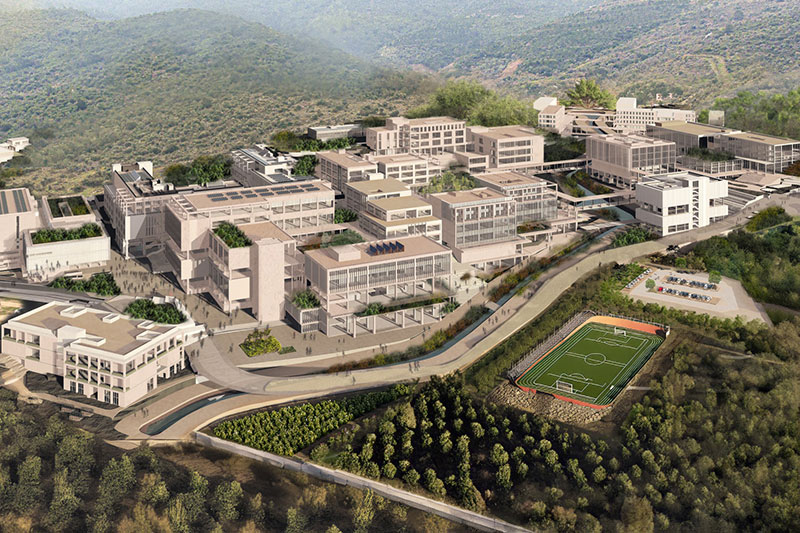
IZMIR UNIVERSITY OF ECONOMICS GÜZELBAHÇE CAMPUS
DetailsGLOBAL CAREER
As Izmir University of Economics transforms into a world-class university, it also raises successful young people with global competence.
More..CONTRIBUTION TO SCIENCE
Izmir University of Economics produces qualified knowledge and competent technologies.
More..VALUING PEOPLE
Izmir University of Economics sees producing social benefit as its reason for existence.
More..
You are one step ahead with your graduate education at Izmir University of Economics.